


Venezuela
How well is Venezuela respecting people's human rights?
Use the tabs below to explore the scores.
Venezuela at a glance
Quality of Life
Economic and Social Rights
(2023)
Summary score
N/A
How well is Venezuela doing compared to what is possible at its level of income?
Right to
0
% of income adjusted benchmark achieved
HRMI score
100%
Very bad
Bad
Fair
Good
Summary score
N/A
How well is Venezuela doing compared to the best in the world?
Right to
0
% of global best benchmark achieved
HRMI score
100%
Very bad
Bad
Fair
Good
Safety from the State
Civil and Political Rights
(2025)
Summary score
3.3
How well is Venezuela's government respecting each right?
Right to freedom from
0
Score
10
Very bad
Bad
Fair
Good
Empowerment
Civil and Political Rights
(2025)
Summary score
3.0
How well is Venezuela's government respecting each right?
Right to
0
Score
10
Very bad
Bad
Fair
Good
Source: HRMI 2026 rightstracker.org
Quality of Life
For Venezuela no rights scores are available due to missing data in the relevant international databases. With more funding, HRMI could investigate the reason for each data gap, and explore ways to help fill it.
For Venezuela no rights scores are available due to missing data in the relevant international databases. With more funding, HRMI could investigate the reason for each data gap, and explore ways to help fill it.
Safety from the State
Venezuela's Safety from the State score of 3.3 out of 10 suggests that a great many people are not safe from one or more of the following: arbitrary arrest, torture and ill-treatment, forced disappearance or extrajudicial killing.
For civil and political rights, we don't have sufficient data across Americas countries to allow for a regional comparison. However, when compared to the other countries in our sample, Venezuela is performing worse than average on the right to be safe from the state.
Empowerment
Venezuela's Empowerment score of 3.0 out of 10 suggests that a great many people are not enjoying their civil liberties and political freedoms (freedom of speech, assembly and association, democratic rights, and religion and belief).
For civil and political rights, we don't have sufficient data across Americas countries to allow for a regional comparison. However, when compared to the other countries in our sample, Venezuela is performing worse than average on empowerment rights.
Quality of Life - overview
(2023)
How well is Venezuela doing compared to what is possible at its level of income?
Summary score
0
% of income adjusted benchmark achieved
HRMI score
100%
Right to
Very bad
Bad
Fair
Good
How well is Venezuela doing compared to the best in the world?
Summary score
0
% of global best benchmark achieved
HRMI score
100%
Right to
Very bad
Bad
Fair
Good
Income adjusted benchmark
Global best benchmark
Source: HRMI 2026 rightstracker.org
For Venezuela no rights scores are available due to missing data in the relevant international databases. With more funding, HRMI could investigate the reason for each data gap, and explore ways to help fill it.
For Venezuela no rights scores are available due to missing data in the relevant international databases. With more funding, HRMI could investigate the reason for each data gap, and explore ways to help fill it.
Quality of Life - full details
See more detail on how Venezuela performs on the
?Right to
0
% of income adjusted benchmark achieved
HRMI score
100%
Right to
Very bad
Bad
Fair
Good
Source: HRMI 2026 rightstracker.org
By sex
How does Venezuela perform by sex for
?By sex
0
% of income adjusted benchmark achieved
HRMI score
100%
Very bad
Bad
Fair
Good
Source: HRMI 2026 rightstracker.org
To see how Venezuela's performance by sex has changed over time for a specific indicator, use the Over time graph below and select the indicator from the menu.
Over time
How does Venezuela perform over time for
using the 'Income adjusted' benchmark and 'Low and middle income' assessment standard?Source: HRMI 2026 rightstracker.org
People at risk
(2025)
Which people in Venezuela were identified by human rights experts to be particularly at risk of having their
violated?Interpretation: Larger text = more human rights experts identified this group as being at risk.
Source: HRMI 2026 rightstracker.org
When asked to provide more context about who was particularly unlikely to enjoy their right to education in 2025, our respondents mentioned all of the following:
-
All people, due to underfunding of public schools, lack of materials, low attendance, poor infrastructure, heavily politicised curriculums, low teacher salaries, and teacher shortages
-
Children, due to needing to skip school or drop out to help their families economically, as well as malnutrition impeding their ability to learn or walk long distances to school
-
University students, due to political interference, budget cuts, and academic freedom restrictions
-
People in fishing towns
-
It is common for teachers to only be available two days a week due to low pay and lack of transportation, contributing to low levels of literacy in the country, especially in rural areas
Safety from the State - overview
(2025)
How well is Venezuela's government respecting each right?
Summary score
0
Score
10
Right to freedom from
Very bad
Bad
Fair
Good
Source: HRMI 2026 rightstracker.org
Venezuela's Safety from the State score of 3.3 out of 10 suggests that a great many people are not safe from one or more of the following: arbitrary arrest, torture and ill-treatment, forced disappearance or extrajudicial killing.
For civil and political rights, we don't have sufficient data across Americas countries to allow for a regional comparison. However, when compared to the other countries in our sample, Venezuela is performing worse than average on the right to be safe from the state.
Over time


Source: HRMI 2026 rightstracker.org
People at risk
(2025)
Which people in Venezuela were identified by human rights experts to be particularly at risk of having their Safety from the State violated?
Interpretation: Larger text = more human rights experts identified this group as being at risk.
Source: HRMI 2026 rightstracker.org
Right to freedom from arbitrary arrest
When asked to provide more context about who was especially vulnerable to arbitrary or political arrest and detention by government agents in 2025, our respondents mentioned all of the following:
-
Anyone who opposes the government, especially students, professors, journalists, human rights advocates, women, and girls
-
Leaders of political opposition parties, such as Juan Pablo Guanipa
-
Members of political opposition parties affiliated with the Democratic Unitary Platform (PUD) alliance
-
People who denounce the government on social media
-
Protesters, political opponents, members of labour unions, and activists are frequently detained on false accusations of terrorism or incitement to hatred
-
Members of non-governmental organisations
-
People living in mining areas
-
Venezuela employs a ‘revolving door’ system of political imprisonment, where people are arbitrarily imprisoned then conditionally released, only to be detained again under new false charges, creating constant fear and uncertainty in detainees and their families and increasing the influence authorities hold over them
Right to freedom from forced disappearance
When asked to provide more context about who was especially vulnerable to disappearance by government agents in 2025, our respondents mentioned all of the following:
-
Anyone who opposes the government, especially students, professors, journalists, human rights advocates, women, and girls
-
Protesters, political opponents, members of labour unions, and activists are frequently detained on false accusations of terrorism or incitement to hatred
-
People who denounce the government on social media
-
Victims of political detentions and arbitrary arrests, due to incommunicado detention for days or weeks before seeing a judge and the frequent use of torture in this time to make a false confession
-
Detainees, due to the authorities concealing their location or denying their detention
-
There are reports of detainees being reportedly released but their whereabouts remain unknown
-
Enforced disappearances are used as a method of intimidation, punishment, and psychological pressure against detainees and their families
-
Members of political opposition parties affiliated with the Democratic Unitary Platform (PUD) alliance
Right to freedom from extrajudicial execution
When asked to provide more context about who was especially vulnerable to extrajudicial killing by government agents in 2025, our respondents mentioned all of the following:
-
All people, especially young men, despite underreporting
-
Anyone who opposes the government, especially students, professors, journalists, human rights advocates, women, and girls
-
People who denounce the government on social media
-
Members of political opposition parties affiliated with the Democratic Unitary Platform (PUD) alliance
-
Members of the military who are accused of disloyalty
-
Detainees, due to extreme torture, the denial of medical care, and poor conditions in detention centres
-
Detainees are held incommunicado for long periods in clandestine detention centres before being extrajudicially killed
-
Extrajudicial killings are committed by state security forces, special operations units, and paramilitary groups known as ‘Colectivos’, especially against protesters
Right to freedom from torture and ill-treatment
When asked to provide more context about who was especially vulnerable to torture and ill-treatment by government agents in 2025, our respondents mentioned all of the following:
-
Anyone who opposes the government, especially students, professors, journalists, human rights advocates, women, and girls
-
Members of political opposition parties affiliated with the Democratic Unitary Platform (PUD) alliance
-
Members of the military who are accused of disloyalty
-
People who denounce the government on social media
-
Political prisoners
-
Detainees in official or clandestine detention centres throughout the country, especially in El Helicoide and the General Directorate of Military Counterintelligence (DGCIM) headquarters in Caracas
-
Detainees and prisoners are regularly subjected to psychological and physical forms of torture, such as sleep deprivation, strangulation, electric shocks, and the torturing of their family members
-
Election observers for the 2024 presidential elections and journalists who covered the elections
-
Indigenous communities, especially those that are isolated, are frequently extorted and mistreated by security forces
-
Indigenous peoples, especially Pemón and Yanomami people, who oppose exploitation in the Orinoco Mining Arc
-
People living in mining areas
-
People suspected of criminal activity, especially young men
-
Health care professionals
-
Torture and ill-treatment are common during any arrest
Empowerment - overview
(2025)
How well is Venezuela's government respecting each right?
Summary score
0
Score
10
Right to
Very bad
Bad
Fair
Good
Source: HRMI 2026 rightstracker.org
Venezuela's Empowerment score of 3.0 out of 10 suggests that a great many people are not enjoying their civil liberties and political freedoms (freedom of speech, assembly and association, democratic rights, and religion and belief).
For civil and political rights, we don't have sufficient data across Americas countries to allow for a regional comparison. However, when compared to the other countries in our sample, Venezuela is performing worse than average on empowerment rights.
Over time


Source: HRMI 2026 rightstracker.org
People at risk
(2025)
Which people in Venezuela were identified by human rights experts to be particularly at risk of having their Empowerment violated?
Interpretation: Larger text = more human rights experts identified this group as being at risk.
Source: HRMI 2026 rightstracker.org
Right to assembly and association
When asked to provide more context about who was especially vulnerable to restrictions on their rights to assembly and association by the government or its agents in 2025, our respondents mentioned all of the following:
-
Civil society organisations are required to provide the government with private documents in order for the state to authorise their operations, forcing many organisations to cease operations or act in secrecy, since the passing of the 2024 ‘Anti-solidarity law’, the Law on Control, Regularization, Operations and Financing of Non-Governmental and Related Organisations
-
Civil society organisations are forced to appear before civil registries and disclose information about their donors and members to comply with Venezuela's laws, severely restricting their ability to receive funding and compromising their security, and very few are able to successfully register or update their registration
-
Certain organisations aligned with the government are allowed to operate to create the appearance of free association
-
Non-governmental organisations, especially those involved in human rights advocacy or political opposition activities
-
Social movements, especially when advocating for freedom of speech or the right to information
-
Members of political opposition parties associated with the Democratic Unitary Platform (PUD) alliance, such as María Corina Machado’s Vente Venezuela
-
Leaders of political opposition parties are frequently arrested on false charges
-
Members of homeowner associations, called ‘juntas de condominio’, who oppose the government
-
Family members and friends of political detainees
-
The government closely surveils and monitors people and organisations through state security forces, paramilitary groups, Local Committees for Supply and Production (CLAPS), and the Units of Battle Hugo Chavez (UBCh)
-
Public reunions are generally prohibited and met with force by the police or paramilitary groups, particularly those for political opposition parties
Right to opinion and expression
When asked to provide more context about who was especially vulnerable to restrictions on their rights to opinion and expression by government agents in 2025, our respondents mentioned all of the following:
-
All people, due to the normalisation of self-censorship
-
People who speak out against the government, especially public officials, political activists, researchers, radio professionals, and members of the military
-
People who express opinions opposing or questioning the government, especially on social media and WhatsApp, are frequently detained, disappeared, extrajudicially killed, or tortured
-
Political opposition parties, especially those that are affiliated with the Democratic Unitary Platform (PUD) alliance, such as Vente Venezuela, Voluntad Popular, and Copei
-
Non-governmental organisations, particularly due to the laws preventing foreign funding
-
Traditional media such as newspapers, television, radio stations, and magazines are heavily controlled by the government
-
Members of the National Union of Press Workers (SNTP)
-
Journalists and members of the press who covered the election results and related protests, due to mass arrests and detentions
-
People seeking to denounce their abusers, especially women, girls, and children, who are victims of harassment, sexual abuse, sex trafficking, arbitrary detention, or forced disappearances
-
People are incentivised to inform the government when friends or neighbours criticise the government, particularly since the 2024 presidential elections
-
The government restricts access to international news and social media sites, such as Twitter/X and YouTube
Right to participate in government
When asked to provide more context about who was especially vulnerable to restrictions on their political participation by the government or its agents in 2025, our respondents mentioned all of the following:
-
All people who are not part of the ruling party, United Socialist Party of Venezuela (PSUV)
-
Political opposition parties, especially those that are affiliated with the Democratic Unitary Platform (PUD) alliance, such as Vente Venezuela
-
All leaders of the political opposition are disqualified from running for election, harassed, persecuted, and often imprisoned, such as key opposition leaders in exile, María Corina Machado and Edmundo González
-
Rafael Tudares, political prisoner and son-in-law of presumed winner of the 2024 presidential elections Edmundo González, was forcibly disappeared for over a year and condemned to prison
-
Millions of Venezuelans living abroad cannot vote, despite being eligible
-
Elections are neither free nor fair, and the electoral authority has faced criticism for lack of independence from the ruling party
Right to freedom of religion and belief
When asked to provide more context about who was especially vulnerable to restrictions on their freedom of religion and belief by the government or its agents in 2025, our respondents mentioned all of the following:
-
Any religious group or leader who opposes the government or denounces the humanitarian crisis is persecuted and harassed by state officials
-
Several churches are unable to register under the ‘Anti-solidarity law’, the Law on Control, Regularization, Operations and Financing of Non-Governmental and Related Organisations
-
Catholic churches are restricted from holding large events
-
Indigenous peoples, such as the Pemón and Warao, whose sacred lands are destroyed and exploited by the mining industry, state control, and non-state armed groups
-
Certain religious groups receive government funding and favourable treatment in exchange for political loyalty, to counter the influence of the Catholic Church and evangelical churches who demand respect for human rights - Antisemitic speech and actions have increased
-
Antisemitic speech and actions have increased amid the Israeli government’s actions and Venezuela’s strong pro-Palestinian stance, which, while not directly causing antisemitism, contributes to a climate where such behavior is tolerated.
Which people are most at risk?
We asked human rights experts to choose from a list of options for which people were particularly at risk of having this right violated. The images below show their answers.
Highlight
in the word clouds below.Quality of Life
People at risk for
Right to education
(2025)
Interpretation: Larger text = more human rights experts identified this group as being at risk.
Source: HRMI 2026 rightstracker.org
People at risk for
Right to food
(2025)
Interpretation: Larger text = more human rights experts identified this group as being at risk.
Source: HRMI 2026 rightstracker.org
People at risk for
Right to health
(2025)
Interpretation: Larger text = more human rights experts identified this group as being at risk.
Source: HRMI 2026 rightstracker.org
People at risk for
Right to housing
(2025)
Interpretation: Larger text = more human rights experts identified this group as being at risk.
Source: HRMI 2026 rightstracker.org
People at risk for
Right to work
(2025)
Interpretation: Larger text = more human rights experts identified this group as being at risk.
Source: HRMI 2026 rightstracker.org
Safety from the State
People at risk for
Safety from the State
(2025)
Interpretation: Larger text = more human rights experts identified this group as being at risk.
Source: HRMI 2026 rightstracker.org
Empowerment
People at risk for
Empowerment
(2025)
Interpretation: Larger text = more human rights experts identified this group as being at risk.
Source: HRMI 2026 rightstracker.org
Behind the numbers
Quality of Life
Under the International Covenant on Economic, Social, and Cultural Rights, which China has signed, all countries commit to using the maximum of their available resources to progressively improve rights for their people in these areas.
HRMI has calculated what China could be achieving at its current level of income. The scores are given as a percentage of that realistic potential achievement. China’s best score is for the right to work, where its score of 99.2% means it is doing 99.2% of what it possibly can, given its current level of income.
China also has good scores for the right to health (97.8%), and the right to food (96.5%). For these rights, China is doing nearly as well as it possibly can, given its income. Its right to housing score of 94.6% is at the top of HRMI’s ‘fair’ range.
One of China’s lowest scores is for the right to quality education, where it scores 66.2%, which falls in the ‘very bad’ range. Among 6 East Asian countries and territories with data, this score puts China at the bottom for quality education, just below Mongolia.
Right to Quality Education in East Asia
Score
0
% of income adjusted benchmark achieved
HRMI score
100%
The right to housing includes scores for the right to sanitation and the right to water.
With a GDP per capita of US$12,951 in 2023, China has the resources to ensure all its people have running water and toilets in their homes.
However, China’s right to sanitation score of 94.9% shows that it could afford to do better. If China efficiently used its available resources, it could achieve a score of 100%, which would mean that 39.2 million more people could have access to basic sanitation.


When it comes to the higher standard of safely managed sanitation, China’s score of 73.6% means that if China effectively and efficiently used its available resources an additional 350 million people could have access to safe sanitation.

If China improved its performance on the right to water from its current score of 94.3% to 100%, 59.8 million more people would have water on their premises.
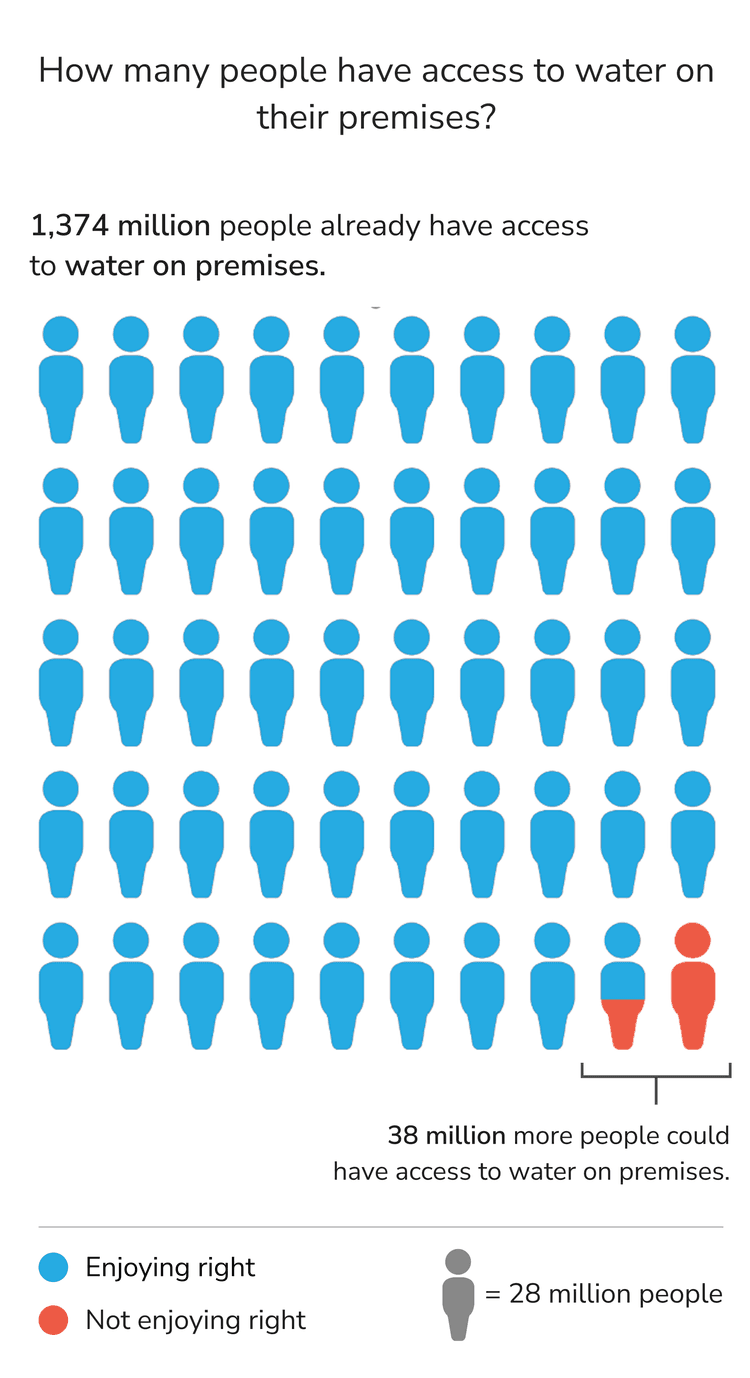
The good news is that China’s scores for the right to housing have improved steadily over the past decade. China’s score on the right to basic sanitation increased by 20.5 percentage points and that of the right to water by over 9.2 percentage points. The gains have been even greater for safe sanitation. Here China’s score rose from 50.8% to 73.6%, an increase of nearly 23 percentage points. China’s improvements in income adjusted scores show that country’s policies have become more effective at turning resources into good human rights outcomes.
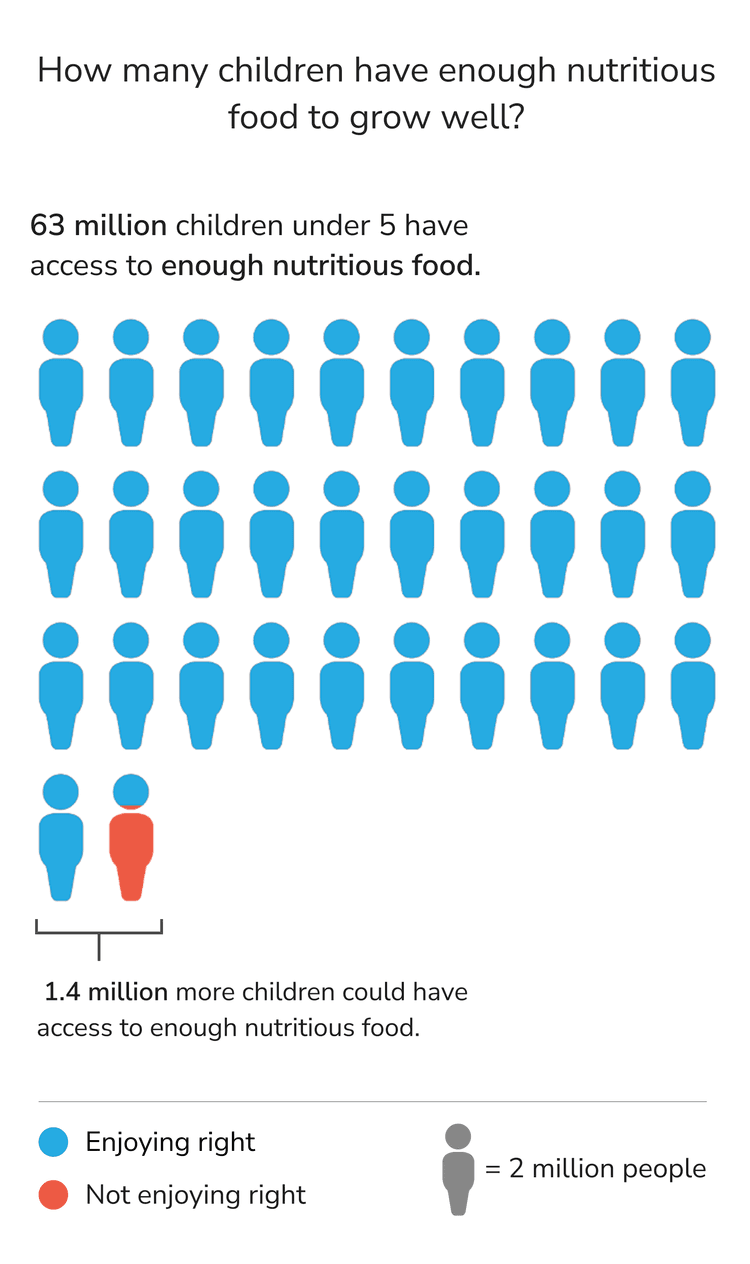
When it comes to the right to food, if China lifted its current score of 96.5% to 100%, around 1.2 million more children under five years old would have enough nutritious food to grow well – that would mean all children in China under five would have enough nutritious food to grow well. This is an achievable goal.
With a current score of 96.5%, China has improved in respecting people’s right to food over the last 20 years, with its score increasing markedly from 84.1% in 2000.
On the right to work, China has made dramatic progress in eliminating absolute poverty. Its score on ensuring people enjoy at least a subsistence income (that is, income above the absolute poverty line of $4.20 per day, measured in 2021 PPP$), has risen from 37.4% in 2002 to 99.2% in 2022, nearly eliminating absolute poverty.

The bigger challenge China currently faces, however, is eliminating relative poverty. That is, ensuring people enjoy at least half the median income and can therefore enjoy a decent life. China’s score on a fair (relative) income stood at only 37.5% in 2018 (the most recent year with data). Projecting the relative poverty rate forward to 2023, this means that while nearly 1,124 million people have enough money to enjoy decent lives, over 213 million are unnecessarily denied this right.

China comes second in the world in using its available resources to ensure people’s right to health is fulfilled, with a score of 97.8%. This is the right where China is most constrained by resources. An increase in income will be necessary to make significant further improvements.
However, at its current income level, China should already be able to do as well as any country in the world in meeting the rights to food, housing, and work.
People at risk
While China has room for improvement in all the rights we measure, a further consideration is inequity. There are several groups of people whom experts identified as being at higher risk of missing out. These include:
- People with lower social or economic status, including farmers and people in rural areas, remote, mountainous or underdeveloped areas
- Human rights advocates, protesters, activists, and anyone who criticises the government; and their family members
- People who are blacklisted by the government for political reasons
- People from ethnic minorities, including Uyghurs, Tibetans, and Mongolians
- People in Xinjiang, especially Uyghurs
- People in Tibet
- People with disabilities
- Older people
- People in prison
- People from religious minorities
- People who are stateless or are not in the household registration system
- People who are homeless
See the people at risk tab on the Rights Tracker for the full lists. The data also show a strong connection between political activity, especially criticism of the government, and lack of enjoyment of economic and social rights.
Room for improvement
China has made outstanding progress in ensuring people enjoy their basic economic and social rights. However, all of China’s Quality of Life scores show that the country could still make significant improvements to its people’s lives by using its existing resources more effectively.
If China were using its resources more efficiently to ensure its people’s wellbeing, it could achieve 100% for all the rights we measure. Yet, while its best score nearly reaches that goal – 99.2% on right to a subsistence income – its worst score using the low and middle income country assessment standard – 66.2% on the right to quality education – is far from that level.
If China better upheld its rights obligations and achieved a full 100% score on all the rights we measure, we would see millions more Chinese people living lives of dignity. For example, if China’s scores reached 100% we would see the following number of extra people benefitting:
-
If China were to operate at its full potential given its current resources, we would expect an additional nearly 1.2 million children under five to grow well and not be stunted.
-
If China were operating at best practice, each year we would expect an extra 12,600 newborn baby girls and 13,400 newborn baby boys to survive until their fifth birthday.
-
If China were to operate at its full potential given its current resources, we would expect 92,300 more newborns to be born at a healthy birth weight.
-
If China were reaching its full potential, given its income constraints, an extra 159,000 15-year-old girls and 419,000 15-year-old boys could eventually reach the age of at least 60.
-
If China used its resources efficiently, an additional 39.25 million people could have access to basic sanitation at home, 350 million could have access to safe sanitation at home, and an extra 60 million people could have access to water in their homes.
-
If China were operating at its full potential given its current resources, it could lift over 213 million people out of relative poverty.**
Safety from the State
China scores 3.1 out of 10 for our overall Safety from the State category, telling us that a great many people are at risk of arbitrary or political arrest or detention, torture and ill-treatment, forced disappearance, execution, or extrajudicial killing. This is one of the lowest scores in our sample of 40 countries.
One of China’s lowest scores in this category is 2.1 out of 10 for freedom from torture and ill-treatment.
The human rights experts we surveyed said that people protesting against or criticising the government, people from ethnic and religious minorities, and people in prisons or being questioned by police were at extra risk of being tortured or ill-treated.
Respondents overwhelmingly agreed that human rights advocates, protesters, journalists, and people who criticised the Chinese Communist Party were at particular risk of a wide range of rights violations, especially arbitrary arrest and detention, forced disappearance, and torture and ill-treatment. Respondents particularly noted risks to political dissidents, detainees, and people supporting democracy.
Other vulnerable groups include:
- Detainees and those accused of crimes, especially people suspected of terrorism
- Anyone criticising the government
- Journalists
- People in Tibet, Xinjiang and Hong Kong
- Muslims, Christians, and people following other religions such as Falun Gong
Among other East Asian countries and territories where we measure these rights, China has among the lowest scores for all five Safety from the State rights, generally equal with North Korea.
Right to Freedom from Arbitrary Arrest and Detention in East Asia
Summary score
0
Score
10
Right to Freedom from Forced Disappearance in East Asia
Summary score
0
Score
10
Right to Freedom from Death Penalty in East Asia
Summary score
0
Score
10
Right to Freedom from Extrajudicial Execution in East Asia
Summary score
0
Score
10
Right to Freedom from Torture and Ill-treatment in East Asia
Summary score
0
Score
10
Empowerment
The Chinese government limits civil liberties and political freedom, with China scoring a very low 2.5 out of 10 in empowerment rights. This is one of the lowest scores in our sample of 39 countries, with only North Korea doing worse.
For the rights to assembly and association, opinion and expression, participation in government, and freedom of religion and belief all of China’s scores fall into the ‘very bad’ range.
When it comes to the right to assembly and association, China scores 2.2 out of 10, and human rights experts identified a wide range of people not enjoying their rights, including human rights advocates, protesters, and people criticising or opposing the government, as well as those from ethnic and religious minorities.
China’s score for the right to opinion and expression is a very low 3.1 out of 10. Respondents highlighted restrictions on political expression. They also noted that online expression is also restricted and reported widespread surveillance and censorship.
China also scores in the ‘very bad’ range for the right to participate in government, with a score of 2.4 out of 10. Respondents noted that pro-democracy supporters, including those in the New Citizens’ Movement, the Southern Street Movement, the China Democracy Party, the White Paper Movement, and independent candidates were not free to participate in government. They also said that people from religious or ethnic minorities could not exercise their democratic rights freely.
For the right to freedom of religion and belief, China scored 2.9. Respondents noted that the government restricts all religious practices, and is particularly repressive towards people following unregistered minority religions such as Christians, Uyghur Muslims, Falun Gong members, and people who attend house churches.
Groups that are particularly vulnerable to empowerment rights violations include:
- Human rights advocates, protesters, and anyone who criticises the government
- Pro-democracy supporters
- Journalists
- People from ethnic and religious minorities
- Detainees and those accused of crimes
- The general public, because of pervasive surveillance and censorship
Among other East Asian countries and territories where we measure these rights, only North Korea scores worse than China.
Right to Assembly and Association in East Asia
Summary score
0
Score
10
Right to Opinion and Expression in East Asia
Summary score
0
Score
10
Right to Participate in Government in East Asia
Summary score
0
Score
10
Right to freedom of religion and belief in East and Southeast Asia
Summary score
0
Score
10
Transnational repression
The Chinese government engaged in transnational repression in a number of ways in 2025.
Transnational repression is activity that violates the human rights of people outside a government’s own territories.
Where is China engaging in transnational repression?
According to77 human rights expert respondents whose work focuses on China and Hong Kong, in 2025 the Chinese government or its agents targeted people for transnational repression in the following places:
In which countries were people targeted?
Graph shows how many respondents identified each country.
0
Percentage of respondents
100%
0
20
40
60
80
100
How many people were targeted?
Graph shows how many people were targeted in each country, from ‘none’ to ‘a very large number'.
< Less people
Number of people targeted
More people >
None
Very small
Small
Medium
Large
Very large
Experts also gave the following additional information on specific regions where the Chinese government or its agents engaged in transnational repression in 2025:
- Southeast Asia
- East Asia
- Central Asia
- Europe
- Sikkim, India
- Non-democratic countries
- Netherlands
- Italy
- United States
- Thailand
- Kazakhstan
People at risk
According to human rights expert respondents, in 2025 the Chinese government or its agents targeted the following kinds of people for transnational repression:
Who was targeted?
Graph shows how many respondents identified each group of people.
0
Percentage of respondents
100%
Experts gave the following additional information on some of the groups the Chinese government or its agents targeted for transnational repression in 2025:
- Chinese citizens acting abroad who promote democracy
- China-based family members of overseas pro-democracy activists
- Chinese citizens who criticise the Chinese government, especially those living in non-democratic countries that have close ties to China
- Hong Kong activists and dissidents
- Human rights activists
- Human rights lawyers
- People living abroad who advocate for Uyghurs and Tibetans
- Chinese citizens living abroad
- Chinese students abroad
- Foreign journalists
- Members of non-governmental organisations
- Foreign nationals with Uyghur heritage, from countries such as Kazakhstan heritage
- Small business owners
- People in the diaspora
Human rights violations
According to human rights expert respondents, in 2025 the Chinese government or its agents targeted people for transnational repression in the following ways:
Physical harm, harassment, and coercion
- Chinese citizens overseas are harassed and pressured by the Chinese consulate where they reside
- Members of the China Democracy Party who live in the Netherlands have faced threats against themselves and their families
- Family members of pro-democracy activists abroad face harassment within China by the government, including regular visits by government officials, intimidation, threats, and detention
- Chinese international students who study abroad and then return home to China can be detained over political statements made while abroad, such as in the cases of Zhang Yadi and Hu Yang
- Families of dissidents are threatened and harassed in several ways, including freezing banking accounts
- The use of warrants and bounties
Repatriation and overseas law enforcement activity
- Forced returns
- Relatives of dissidents abroad are coerced into cutting contact or persuading targets to return to China
- Uyghur people have been targeted for repatriation, including the arrest of several people in Thailand who were later deported to China
- Misuse of Interpol notices
Legal and financial coercion
- Dissidents are at risk of statelessness when they need to renew passports
- Dissidents are at risk of rejection of pension withdrawals
- Families of dissidents are threatened and harassed in several ways, including freezing banking accounts
Surveillance, digital activity, and suppression of free speech
- The Chinese government exerts its influence overseas through organised groups, Chambers of Commerce, and international student groups
- Chinese ‘Overseas Police Service Stations’ monitor Chinese citizens in the diaspora, particularly in the United States and Italy
- Overseas police stations and covert operations are used for surveillance and intimidation
- The Hong Kong Economic and Trade Office in London is reportedly used to collect intelligence and conduct overseas law enforcement
- There are reports of the government exposing the addresses and locations of Chinese dissidents abroad (doxxing)
- Supporters of the Chinese Communist Party abroad become voluntary agents in the United Kingdom, the United States, and Canada, and provide information about dissidents
- The Chinese government engages in digital harassment
- Overseas police stations and covert operations are used for surveillance and intimidation
- The Chinese government has produced deep-fake, sexually explicit images of activists and distributed them among their communities
- Distribution of flyers with bounty information about activists in the neighbourhoods they live in
- Chinese students at universities in the United Kingdom with links to the Chinese Communist Party monitor comments about China and report those to the government
- People who criticise or oppose the government are barred from entering the country, including foreign journalists, politicians, and activists in Europe
Country details
Population
28.4m (2024)
GDP/capita
$4,218 (2024)
current US dollars